Female Health 30+: Hormonal Balance, Stress and the Body’s Functional Resources
2026-11-17
After the age of 30, women begin to notice gradual changes in their bodies. Work and family demands, chronic stress, lack of sleep, changes in body weight and variations in the menstrual cycle can all affect well-being, emotional state and the quality of recovery.

The age of 30+ is a good time to develop the habit of taking regular care of your health, assessing risk factors and maintaining the body’s functional resources.
During this period, it is particularly important to pay attention to several interconnected areas: hormonal regulation, the functioning of the nervous and endocrine systems, metabolism, bone health, reproductive health and psycho-emotional well-being.
Estrogen and Progesterone: Why Is Hormonal Balance Important?
Estrogens and progesterone are key hormones of the female reproductive system. They are involved in regulating the menstrual cycle, preparing the endometrium, maintaining bone health and influencing the functioning of other body systems. The levels of these hormones naturally fluctuate throughout the menstrual cycle. Hormonal regulation can also be influenced by age, ovulatory function, body weight, physical activity, nutrition, sleep and stress.
In popular literature, the term “estrogen dominance” is often used to describe a situation in which the effects of estrogen are relatively more pronounced than those of progesterone.
This condition occurs when the influence of estrogen on body tissues becomes excessive in relation to progesterone, which normally counterbalances estrogen’s effects. When progesterone levels decrease, estrogen may exert a more pronounced influence.
Other factors can aggravate this situation. Chronic stress and elevated cortisol levels can inhibit ovulation, leading to a decrease in progesterone levels and changes in the way tissues respond to estrogen. This may contribute to what is commonly referred to as estrogen dominance, when estrogen exceeds progesterone in both concentration and its effects on target organs.
Impaired liver function can reduce the efficiency of estrogen elimination. Insulin resistance and excess body weight are also contributing factors, as adipose tissue produces estrogen.
Xenoestrogens are substances found in the environment, including plastics (bisphenol A), cosmetics (parabens) and household chemicals. These compounds have structures similar to estrogen and may interfere with hormonal balance, even when the level of the body’s own hormone in the blood is within the normal range.
The use of certain contraceptives can also alter the estrogen-to-progesterone ratio.
Bone Health, Metabolism and Age-Related Changes
Maintaining bone health is another important aspect of women’s health. Bone mass is influenced by age, genetics, nutrition, physical activity, hormonal status and the body’s supply of calcium and vitamin D.
Every year after the age of 30, women gradually lose a small amount of bone mass. The main “culprit” is the same: estrogen deficiency, along with insufficient calcium and vitamin D intake.
Bone loss may accelerate more noticeably during the menopausal transition and after menopause.
A balanced diet, adequate intake of protein, calcium and vitamin D, and regular weight-bearing physical activity are important for maintaining bone health.
VedaPulse — A Tool for Taking Care of Yourself and Your Health
To obtain an objective assessment of the functional state of a woman’s body after the age of 30 and select an individual wellness programme, we offer an assessment using the VedaPulse system.
The Academic Module
The HF/LF graph shows the relative influence of the sympathetic and parasympathetic divisions of the autonomic nervous system on heart function. It can be used to assess autonomic balance — the relationship between energy mobilisation and recovery processes.
The VLF graph reflects the state of hormonal regulation systems.
The Energy tab: the “Overall Health Level” chart indicates the level of stress tension.
The Metabolism tab: the Biological Aging Rate indicator (0–100 units) assesses the rate at which energy is expended on metabolic processes. Changes in this indicator may point to hormonal dysfunction and reflect the rate of physical ageing.
The Psychophysiology Tab
This tab contains two graphs: Stress Tension Level and Psycho-Emotional State Assessment (anger, anxiety and depression).
The psycho-emotional state assessment helps determine the levels of anxiety, depression and emotional lability, as well as their nature: acute/reactive (for example, reactive anxiety) or chronic.
Serotonin, dopamine and GABA are highly sensitive to fluctuations in estrogen and progesterone levels. This is one of the factors that may contribute to anxiety and unexplained tearfulness in women over 30.
79 units — Stress Tension Level
State of eustress (a narrow normal range) — an optimal response to stressors. Balanced and harmonious functioning of the body’s regulatory systems.
Psycho-Emotional State
- Emotional lability — 7.1 units
- Depression — 2.9 units
- Anxiety — 0.3 units
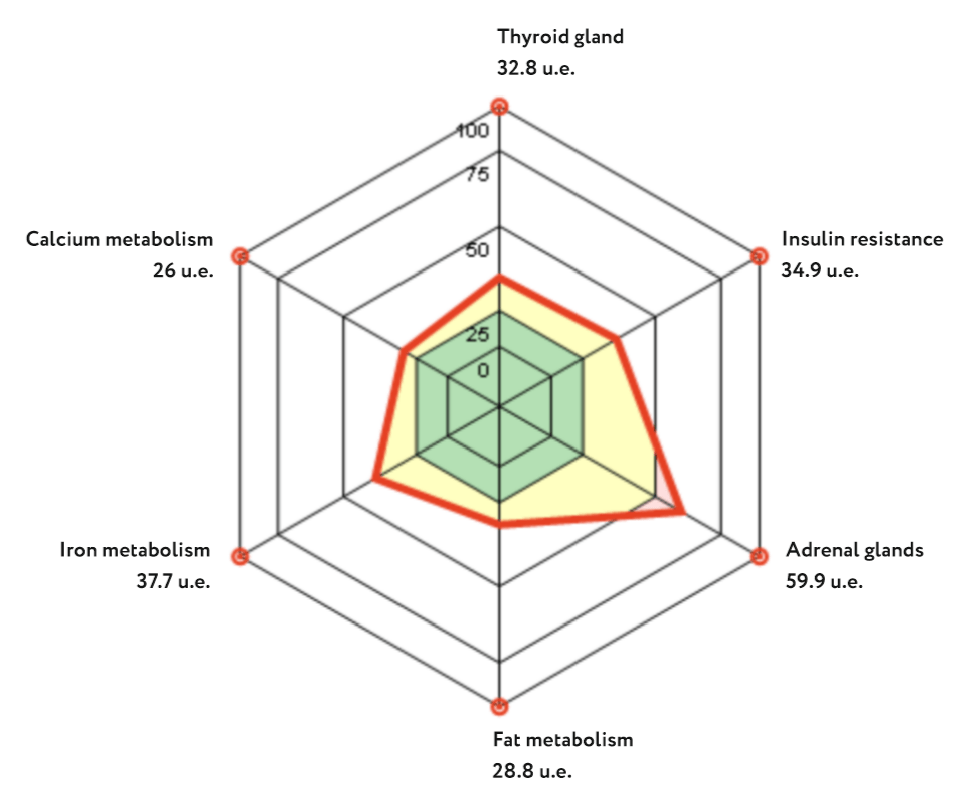
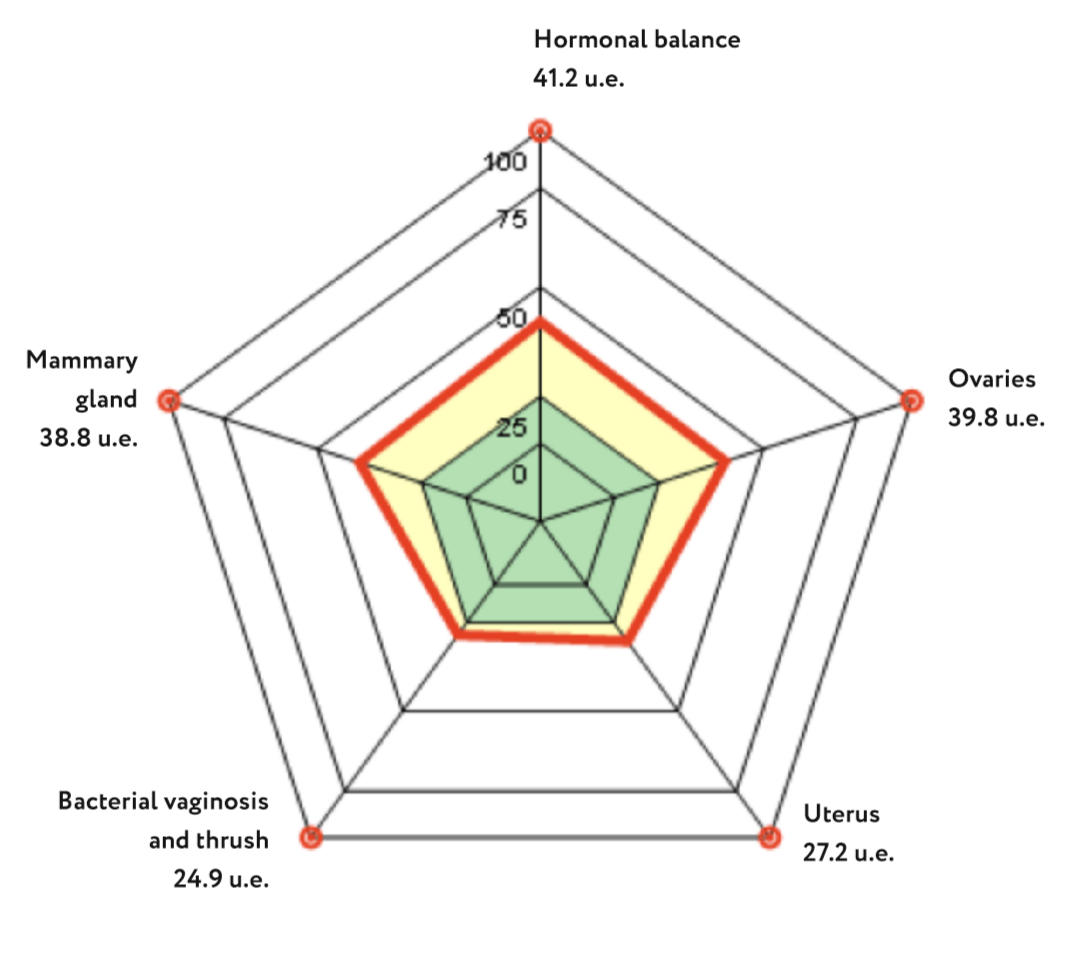
The Biohacking Software Module makes it possible to assess risks associated with the development of diseases and pathological conditions across various body systems, including the reproductive and endocrine systems.
Reproductive System
Hormonal Balance: 41.19 units (Moderate Risk)
- Ovaries: 39.84 units (Moderate Risk)
- Uterus: 27.25 units (Moderate Risk)
- Bacterial Vaginosis and Candidiasis: 24.88 units (Low Risk)
- Breast: 38.78 units (Moderate Risk)
- Overall status: 34.96 units (Moderate Risk)
Endocrine System
- Thyroid gland: 32.81 units (Moderate Risk)
- Insulin resistance: 34.88 units (Moderate Risk)
- Adrenal glands: 59.93 units (High Risk)
- Fat metabolism: 28.85 units (Moderate Risk)
- Iron metabolism: 37.72 units (Moderate Risk)
- Calcium metabolism: 26.02 units (Moderate Risk)
- Overall status: 35.90 units (Moderate Risk)